Modern Factor Analysis for Psychology Research
Conducted on 12th and 13th September, 2023
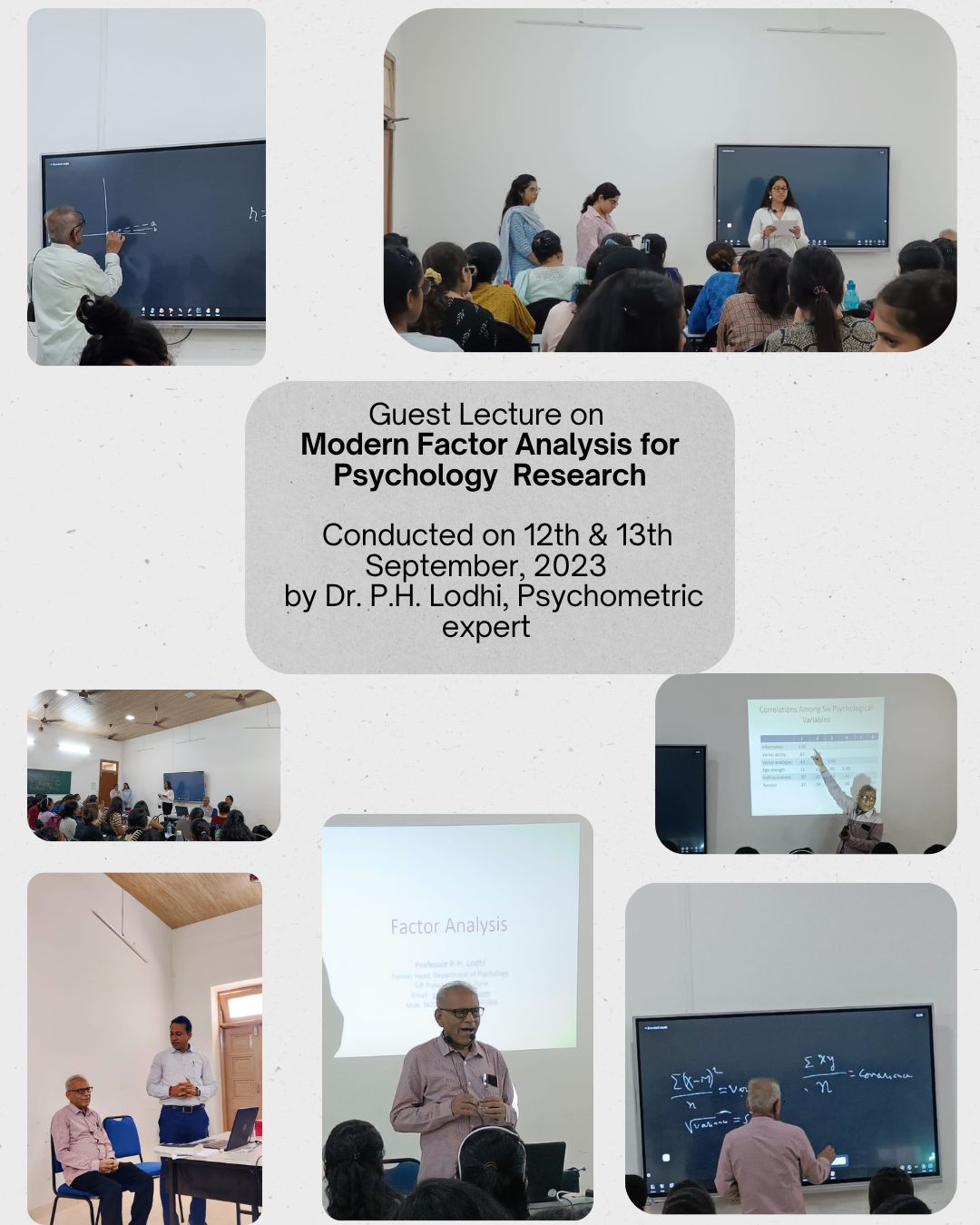
The Department of Psychology organized a two-day workshop on Modern Factor Analysis for Psychology Research, the resource person for the workshop was Professor P.H. Lodhi, Former Head, Department of Psychology of S.P. Pune University, Pune. At the beginning of the session, Dr. Nilesh Thakre, Head, Department of Psychology, SNDTWU welcomed and introduced Dr. Lodhi. The workshop began with a warm welcome given by Ms Tejal Kapadia. Dr. Nilesh Thakre, was then asked to address the audience during which Dr. Thakre thanked Professor Lodhi for accepting the invitation. The workshop started with a review of Preliminary Statistics and the basic understanding and theory of Factor Analysis.
The session began with Dr. Lodhi giving a brief and simplified introduction to Factor Analysis, how the term is defined and how important it is. He spoke on the topic of Preliminary Statistics talking about the basics of statistics such as Variance, Standard Deviation, Standardized Scores and more. He then spoke about correlation and the two families of Correlations: the Product Moment Family and the Correlations outside of the Product Moment Family. Professor Lodhi explained these with the help of examples for ease of understanding of his audience.
He then went on to explain what Factor Analysis is, when it is used and the division of Factor Analysis into two categories: Exploratory and Confirmatory Factor Analysis. The major chunk of Day 1 was dedicated to insights and learning about Exploratory Analysis and the major steps involved in Exploratory Factor Analysis. Prof. Lodhi explained 3 out of the 6 major steps on Day 1 of the workshop and concluded by answering any doubts/ questions that the audience had.
Day 2 of the workshop witnessed similar enthusiasm from the students and professors alike. Teachings of this day helped the students relate to the theory more easily. The first topic taught was the concept of rotation which are of two types: Graphical Rotation and Analytical rotation. He next explained about the criteria for the number of factors retained for rotation. Confirmatory Factor Analysis and the methods involved in its execution were then discussed. There were also questions about comparison of different types of personality tests and a discussion over what to expect, advantages, disadvantages, suppositions and criticisms.
In the last segment of the workshop, Dr Lodhi along with the assistance of Dr Nilesh Thakre demonstrated how factor analysis is carried out in Statistical Package for the Social Sciences (SPSS). Dr. Lodhi pressed on the importance of choosing right variables and steps and being objective, unbiased and flexible with the study and keeping a scientific temper throughout.
Overall, the workshop had been a huge contribution in gaining an understanding of a complex concept such as Factor Analysis. The Department of Psychology was very fortunate to have such an esteemed resource person on board who not only broadened our understanding but also made the process of learning immensely effortless.